Socio-Technical Markets Research Group
The Socio-Technical Markets Research Group explores how markets emerge through the interaction of digital infrastructures, encryption technologies, AI, digital platforms, institutional frameworks, cultural norms, and social relations. Drawing on economic sociology and digital criminology, the research group examines how socio-technical configurations shape the organisation, governance, and everyday practices of licit and illicit economic exchanges. This includes the sociopolitical conditions under which crime, harm, and governance emerge. Its research focuses on digital and hybrid markets, with particular attention to illicit drug markets, platform governance, user practices, gender, and offline-online dynamics. The group also employs qualitative and mixed-methods research to the empirical study of social interactions, processes of trust-building and forms of social organisation within illicit online markets. The group is led by Dr. Meropi Tzanetakis (she/her) at WU Vienna.
Research Activities
The Socio-Technical Markets Research Group conducts interdisciplinary social science research projects, contributes to national and international scholarly debates through publications and conference presentations, engages in third mission activities and public engagement, and collaborates with public institutions and civil society organisations. It also supports student supervision and early-career researchers working on socio-technical configurations, digital platforms, illicit drug markets, and mixed-methods research. Further information on the group's activities is available via the sections Research, News, Publications, Talks, and Teaching.
Research Group Members

Constantin Coeler, BA, MA, MA
PhD Student
Constantin (he/him) is a PhD candidate in Socioeconomics at WU Vienna whose work explores how contested substances are negotiated as medicines, products, and objects of governance. Using qualitative methods, his dissertation investigates the socio-legal and socio-economic embeddedness of psychedelic-assisted therapy, focusing on competing advocacy groups in Germany’s psilocybin compassionate-use pathway, EU-level regulatory dynamics, and Austria’s drug policy potential. His background includes a Bachelor’s degree in Political Sciences and English from the University of Greifswald, a Master’s degree in International Development from the University of Vienna, and a Master’s degree in Social Pedagogy and Social Management from SFU Vienna, complemented by psychotherapy training and over five years of professional experience in psychosocial care.

Jennifer Emilio, BSc
Research Assistant
Jennifer (she/her) is currently pursuing a Master’s degree in Applied Economics at WU Vienna. She holds a Bachelor’s degree in Economics and Business Economics from Maastricht University. Her academic background includes quantitative research methods and data analysis gained through experience in both academic and institutional settings. Her research interests focus on digital markets, public policy, financial systems, and labor markets. She has previously worked on the aerospace labor market as part of the Space Generation Advisory Council (SGAC).

Alexander Pelzer, BA, BSc (WU)
Research Assistant
Alexander (he/him) is currently completing a Master’s degree in Socioeconomics and Philosophy and has been a research assistant at WU Vienna since 2025. He holds a Bachelor’s degree in Business and Economics from WU Vienna University of Economics and Business and a Bachelor’s degree in Philosophy from University of Vienna. His academic interests centre on social transformations in the information age, with a particular focus in his Master’s thesis on the influence of digital technologies on the constitution of subjectivity. He combines historical materialism with cultural evolutionary theory to better understand current sociotechnical transformations, grounding his analysis in qualitative empirical research methods.

Hatice Sit, BSc (WU)
Research Assistant
Hatice (she/her) recently completed her Bachelor’s degree in Business, Economics and Social Science, specializing in Socioeconomics, at WU Vienna. She will begin a Master’s degree in Socio-Ecological Economics and Policy at WU Vienna in October 2026. Since February 2025, Hatice has worked as a student tutor and gained experience in working with qualitative interview data as a working student for an Austrian NPO. Her research interests include social stratification, cultural consumption and inequality. She is particularly drawn to digital spaces as both sites of subcultural practice and as sources of qualitative data, as explored in her undergraduate thesis on consumption practices of the upwardly mobile, using qualitative Reddit data and reflexive thematic analysis.

Polina Elisabeth Alekseev, BA
Teaching Assistant
Polina (she/her) is currently completing a Master’s degree in Socioeconomics at WU Vienna and holds a Bachelor’s degree in European Studies from the University of Passau. Her interdisciplinary academic background combines perspectives from political science, sociology, cultural studies, and economics. Her research interests focus on socio-ecological transformations and heterodox economic perspectives, particularly political economy and feminist economics. She has a strong interest in qualitative research methodology in social sciences, which she has further developed through her work as a Teaching Assistant in qualitative research methods at WU Vienna.

Lisa Rois, BA
Research Assistant
Lisa (she/her) is currently pursuing a Master’s degree in Socioeconomics at WU Vienna University of Economics and Business. She holds a Bachelor’s degree in Social Work and Social Pedagogy from the University of Applied Sciences Vienna. Drawing on her experience in refugee support and social work, her research interests centre on inequality, migration, and gender, with a particular focus on social policy.
Affiliated Research Group Members
Ákos Szigeti, PhD
Postdoctoral Researcher
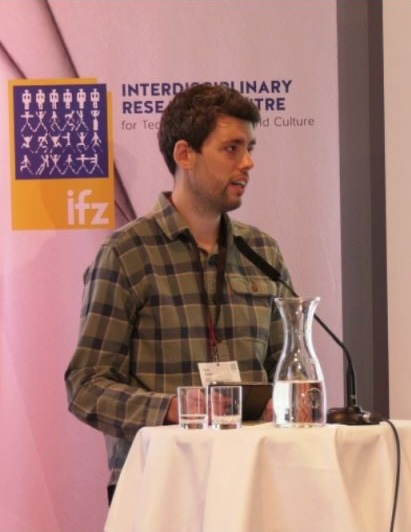
Ákos (he/him) is a postdoctoral researcher at Ludovika University of Public Service, Hungary. His PhD work combined qualitative content analysis with machine learning to better understand the operation of darknet drug markets. Recently he has extended this work by implementing cross-platform exploration of darknet markets, vendor shops, and forums. His research is aimed at describing how digital transformations affect social dynamics and criminal behaviour to inform criminal justice and drug policy discussions. His studies have been published in high-impact peer-reviewed journals such as the Crime Science, the European Journal of Criminology, and the Journal of Contemporary Criminal Justice.
Projects
As part of the ongoing FWF-funded project “A Socio-Technical Framework for Online Drug Markets”, two substudies examine contemporary transformations of hybrid drug markets. The first, conducted in cooperation with the European Union Drugs Agency (EUDA), examines the role of darknet markets in the distribution of increasingly potent synthetic opioids and emerging supply shifts following Afghanistan’s 2022 opium ban, generating evidence relevant to prevention and policy interventions. The second substudy explores how gender relations attentive of intersecting forms of diversity shape engagement with digital infrastructures and socio-technical configurations. It further analyses public health implications of drug use, with particular attention to informing more inclusive harm reduction measures.
Funding
The Research Group’s work is supported through competitive national and institutional research funding. Current projects are funded by an Elise Richter Grant from the FWF Austrian Science Fund and a Matching Grant from WU Vienna University of Economics and Business.
Supervision and collaboration opportunities
The Socio-Technical Markets Research Group welcomes enquiries from students and early-career researchers interested in supervision and collaboration opportunities related to socio-technical configurations, hybrid environments and illicit drug markets. Interdisciplinary projects engaging with qualitative, digital, or mixed-methods approaches are particularly encouraged.
Ongoing supervisions
Constantin Coeler. Socio-Economic Embeddedness of Psychedelic Drug-Therapy Policies in Europe. Qualitative Analysis of Advocacy Coalitions in Switzerland, Germany and Czechia, PhD thesis, WU Vienna.
Jovana Zivkovic. Subjective Perceptions of Safety and Trust in the Use of Social Media and Messenger Apps, BA thesis, BA in Business Information Systems, WU Vienna.
Completed supervisions
Michal Slezinski (2026). Is the European Union becoming a 'Super-Smart-Society'? Societal, strategic and technological comparison with Japan's Society 5.0., MA thesis, Master in Digital Economy, WU Vienna.
Contact Me
Dr. Meropi Tzanetakis